The Word COFEPRIS Hasn't Banned Yet
Opening
Three oncologists in Mérida told me the same thing in April.
"A bottle of natural intimate moisturizer that costs the patient $850 MXN is, in their words, the cheapest line item on the entire cancer treatment plan". One of them said it almost as a complaint. Not because the product is expensive. Because none of the brands selling it have walked into the oncology unit to explain what is actually inside the bottle.
The patient is paying for chemotherapy, for radiotherapy, for aromatase inhibitors that turn vaginal tissue into something that bleeds when she sits down.
She is paying $40,000 MXN a month and crying in a bathroom because intimacy is over and no one warned her.
The natural intimate care category is reading about in European trend reports is sitting one hallway away from her. Unbranded. Untranslated. And until March, describing itself with words that COFEPRIS has now made illegal to use without registration.
There is one word the agency has not touched: Postbiotic.
This month it became the most defensible noun in the Mexican intimate care category. Not because of marketing. Because of what COFEPRIS chose to enforce, and what it chose to leave alone.
Método Yasuri™ : 7/10
Postbiotic intimate care as the regulatorily defensible category
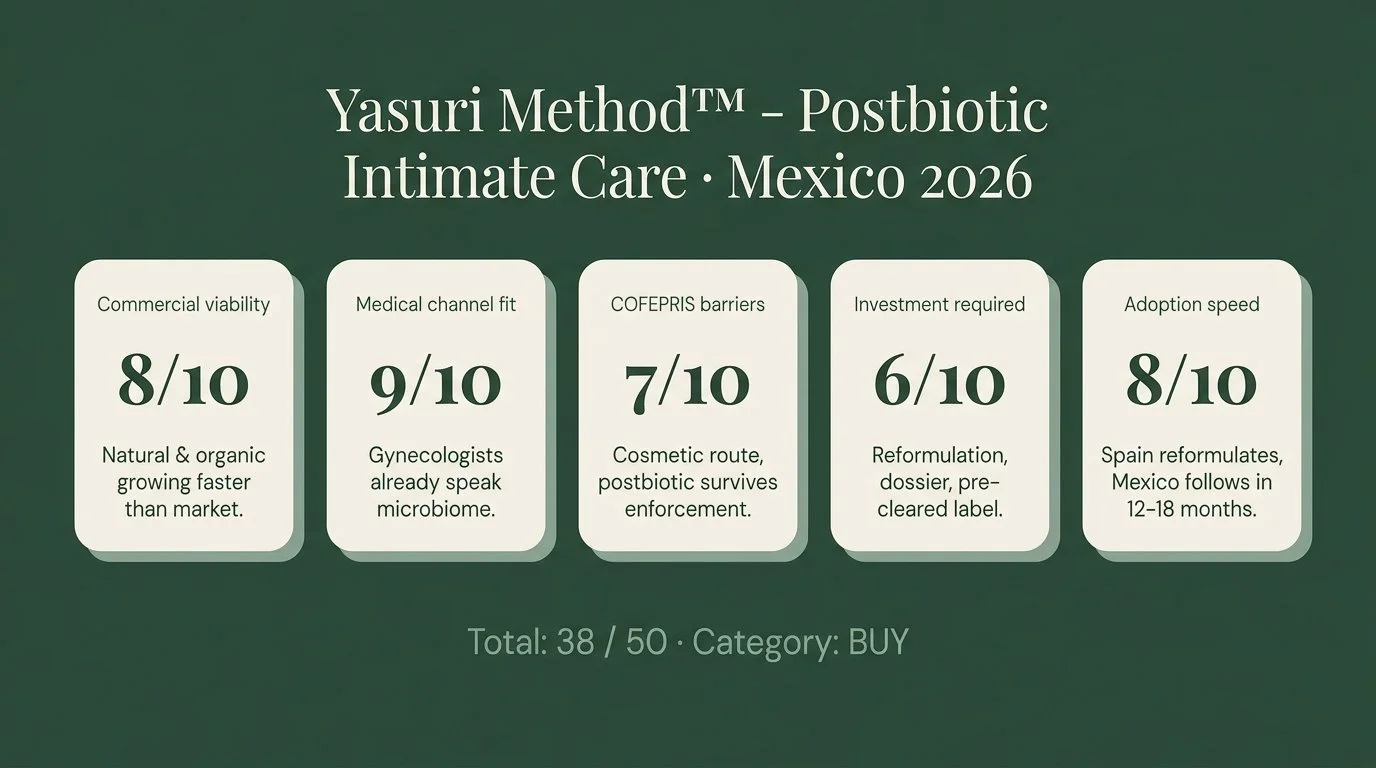
The question is not whether postbiotic-positioned intimate care is a good category. It is. The question is whether Mexico, in May 2026, is the right market and the right moment to enter with that exact angle.
Commercial viability in Mexico: 8/10.
The natural and organic sub-segment of the Mexican personal care market grows at a CAGR of 5.74%. Faster than the conventional segment. Faster than the 5.20% market average. Willingness to pay is documented. Distribution infrastructure exists. The only friction is education, and education is exactly what postbiotic narrative does well.
Adequacy to the Mexican medical channel: 9/10.
This is where the category earns its score. Mexican gynecologists under fifty in private practice are already using microbiome language in consultation. They learned it from international congresses, from Spanish-language webinars, from European pharma reps who have been laying the rails for two years. Postbiótico is not a translation problem. It is a vocabulary they recognize and lack a Mexico-available diferents opcions for.
COFEPRIS regulatory barriers: 7/10 (higher means lower barrier).
Postbiotic, by definition, is the inactivated metabolic product of probiotic strains. It does not contain live microorganisms. That removes it from the insumo para la salud classification trap. It registers as a cosmetic, with cosmetic-grade claims about microbiota balance, hydration, and barrier support. Those three claims survive NOM-141-SSA1/SCFI-2012 labeling rules and the post-VIDA NATURAL enforcement appetite.
The brand that says anti-inflammatory gets a sanitary alert. The brand that says postbiotic that supports intimate microbiota balance does not.
Required investment for entry: 6/10 (higher means lower investment).
Honest reading. Reformulating around postbiotic claims requires clinical documentation, possibly a stability study, a reworked in Spanish dossier, and a label that has been pre-cleared. Above the floor of a generic cosmetic launch. Below the ceiling of an insumo registration. The Mexican distributor will not pay for that work. The brand has to arrive with it done.
Speed of market adoption: 8/10.
The trigger is already pulled. Cumlaude Lab just relaunched its Origyn, Deligyn and CLX intimate hygiene lines reformulated with postbiotics and Mediterranean plant extracts. That is the European farmacia signal. When Spain reformulates, Mexico imports the playbook within twelve to eighteen months. The brand that lands in Mexico inside that window, without a Spanish lab between them and the doctor, wins the conversation.
The combined reading places this category at roughly 38 out of 50. Not a maximum score. A buy.
The Mexican channel that captures this trend first is, again, the medical channel. Specifically the gynecology consultation room in cities with private oncology infrastructure. Mérida. Guadalajara. Monterrey. Querétaro. The private practice clusters in Polanco, Roma and Santa Fe in CDMX.
The naturista channel will absorb postbiotic vocabulary twelve to eighteen months after the medical one. The pharmacy chains will follow when the medical channel has done the legitimization work for them. DTC will not lead this category. It will catch the wave.
Verifiable prediction with timeline. By Q1 2027, at least one Mexican private gynecology network will adopt postbiótico as the recommendation noun for natural intimate care in clinical practice — and at least one European intimate care brand will hold an active COFEPRIS cosmetic registration that uses the postbiotic claim explicitly on its Mexican label.
The brand that gets there first does not need to be the European market leader. It needs to arrive with the dossier finished and a distributor whose phone the gynecologists already answer.
Here's what a European brand has to know before entering with this angle. The Spanish word matters more than the English one. Postbiotic in English is a marketing claim. Postbiótico in Spanish, on a Mexican label, is a regulatory artifact.
And the regulatory artifact is what the gynecologist defends to her patient.
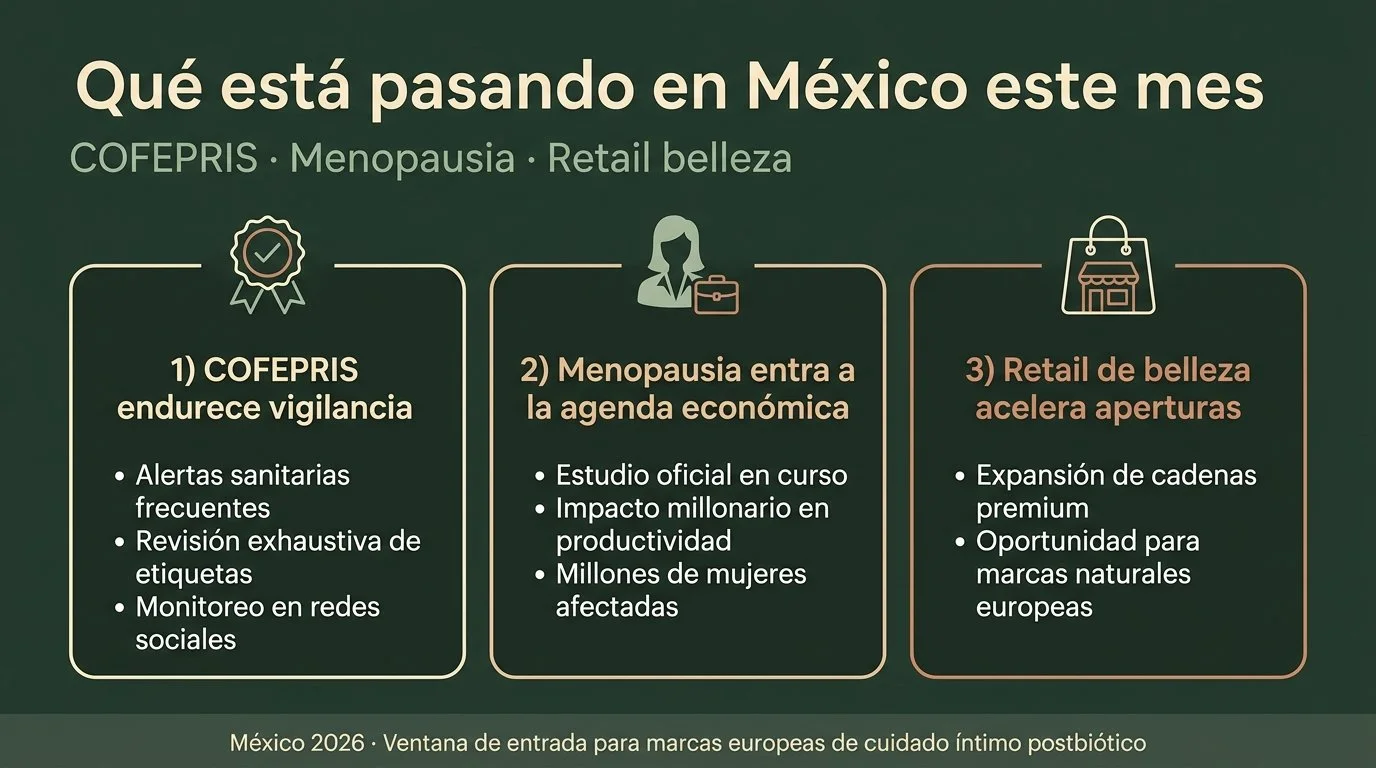
What's happening in Mexico this month?
Three movements between mid-March and late April. Read them together.
COFEPRIS issued a second sanitary alert in the same enforcement cycle on March 26, this one against Dina Distribuidora for misleading advertising of products without sanitary registration — following the VIDA NATURAL alert from March 13. The pattern is clear. The agency is reading social media, comparing label claims to registration class, and acting in two-week intervals. A European brand selling on Instagram with copy translated literally from Swedish marketing materials is now operating inside an active enforcement window.
This is not a quarterly risk. It is a weekly one.
On March 6, UNFPA Mexico and the women's health platform Sin Reglas presented to the Secretaría de Economía a study quantifying the productivity impact of menopause on the Mexican workforce. Twenty-four million women currently in transition. Sixty-seven percent reporting that symptoms affect daily performance. Seventy percent not discussing it with health professionals. The Senate followed on March 19 with a proposal to declare October 18 the National Menopausal Health Day.
What this means for a European brand: the Mexican government just officially recognized a clinical population that the natural intimate care category serves directly. And there is no Mexico-available brand currently positioned to receive that recognition.
Sephora confirmed thirteen new store openings in Mexico for 2026. Mexico is now its second-most-important market globally. Behind only the United Kingdom. Ahead of Brazil. The chain is actively curating clean and natural-positioned brands for the Mexican consumer. For a European intimate care brand with a hero SKU and a clean story, Sephora Mexico is no longer a five-year-out conversation. It is a 2026 conversation, conditional on local registration and a distributor.
CANIPEC reported a near-USD 260 million export surplus in personal care for 2025, consolidating Mexico as the leading cosmetics exporter in Latin America. A brand that registers in Mexico is not just buying a 130-million-person market.
It is buying a regional export base.
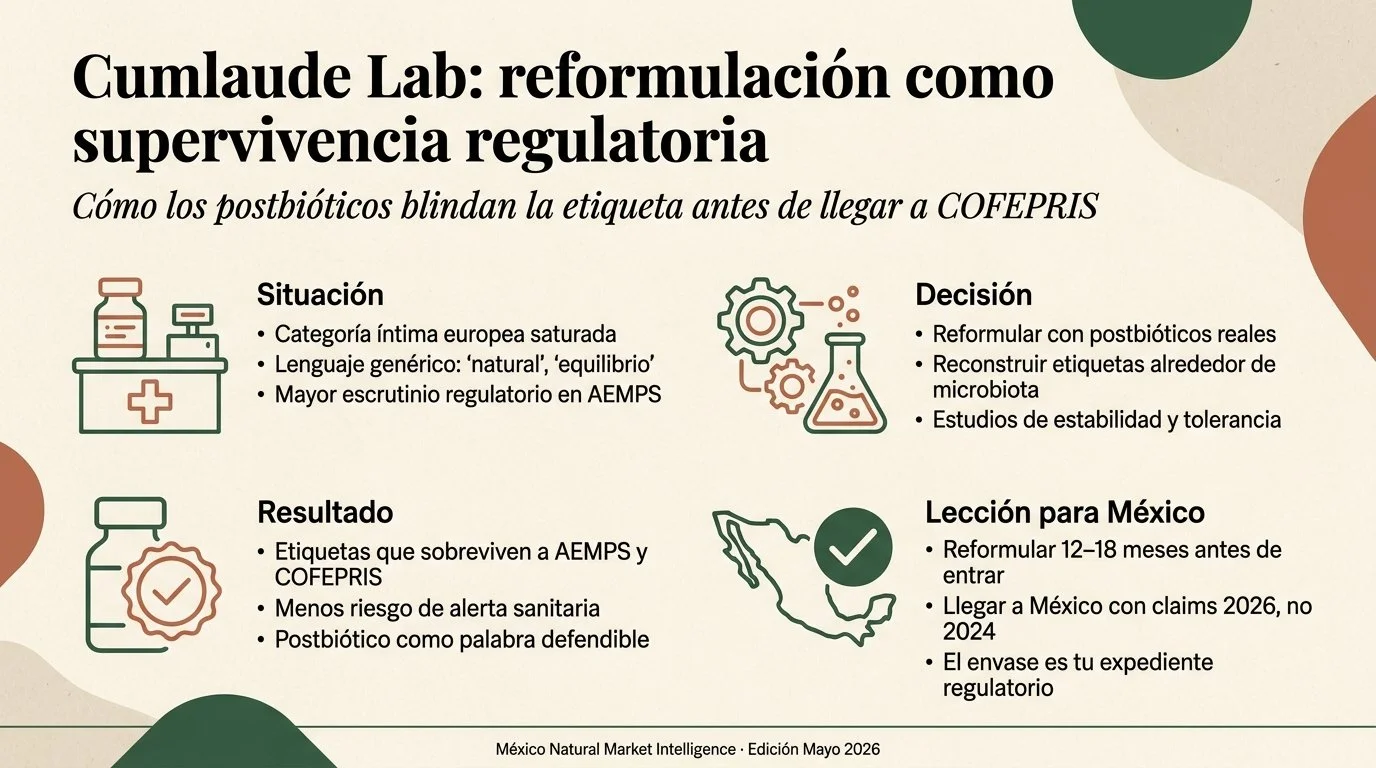
Case study — Cumlaude Lab: reformulation as regulatory survival
Cumlaude Lab is the brand of a Spanish pharmaceutical company specialized in women's intimate health. Its three flagship intimate hygiene lines, Origyn, Deligyn and CLX, have been on the European farmacia channel for over a decade with formulations and claims that worked under European cosmetic regulation.
In April 2026, Cumlaude relaunched all three lines with one operative change. Postbiotics and Mediterranean plant extracts replaced the previous generic natural extract positioning, and the labels were rebuilt around microbiota balance language.
The situation. Cumlaude was not facing a sales problem. It was facing a vocabulary problem. The European intimate care category has been moving toward microbiome and postbiotic language for two years. Cumlaude's existing labels, claims like respects sensitive intimate skin and natural balance, were becoming generic in a category that was getting more specific. At the same time, the Spanish AEMPS tightened scrutiny of intimate hygiene claims.
AEMPS guidance is the bellwether for what COFEPRIS adopts in Mexico twelve to eighteen months later.
The decision. Reformulate. Not relaunch with new marketing, reformulate the actual product. Postbiotics are not a marketing claim if they are physically in the bottle. They are a chemical reality. Cumlaude rebuilt the formulas around fermented active ingredients, ran the stability and tolerance work, and rewrote the labels with claim language that survives both AEMPS and, by extension, COFEPRIS.
The result. Cumlaude now has three SKUs with a regulatory position that, when it lands in Mexico, does not have to be defended. The label is the dossier. The brand will not get a sanitary alert for saying postbiotic. It will get one for saying anti-inflammatory.
The reformulation chose the survivable word.
The lesson for any European intimate care brand looking at Mexico in 2026. Reformulation is not a marketing decision. It is a regulatory survival decision made twelve to eighteen months before the product lands. The brand that arrives in Mexico in 2027 with 2024 European claims has already lost the channel before it ships the first pallet.
The brand that arrives with the postbiotic reformulation already inside the bottle and on the label arrives with COFEPRIS pre-handled.
The window is open.
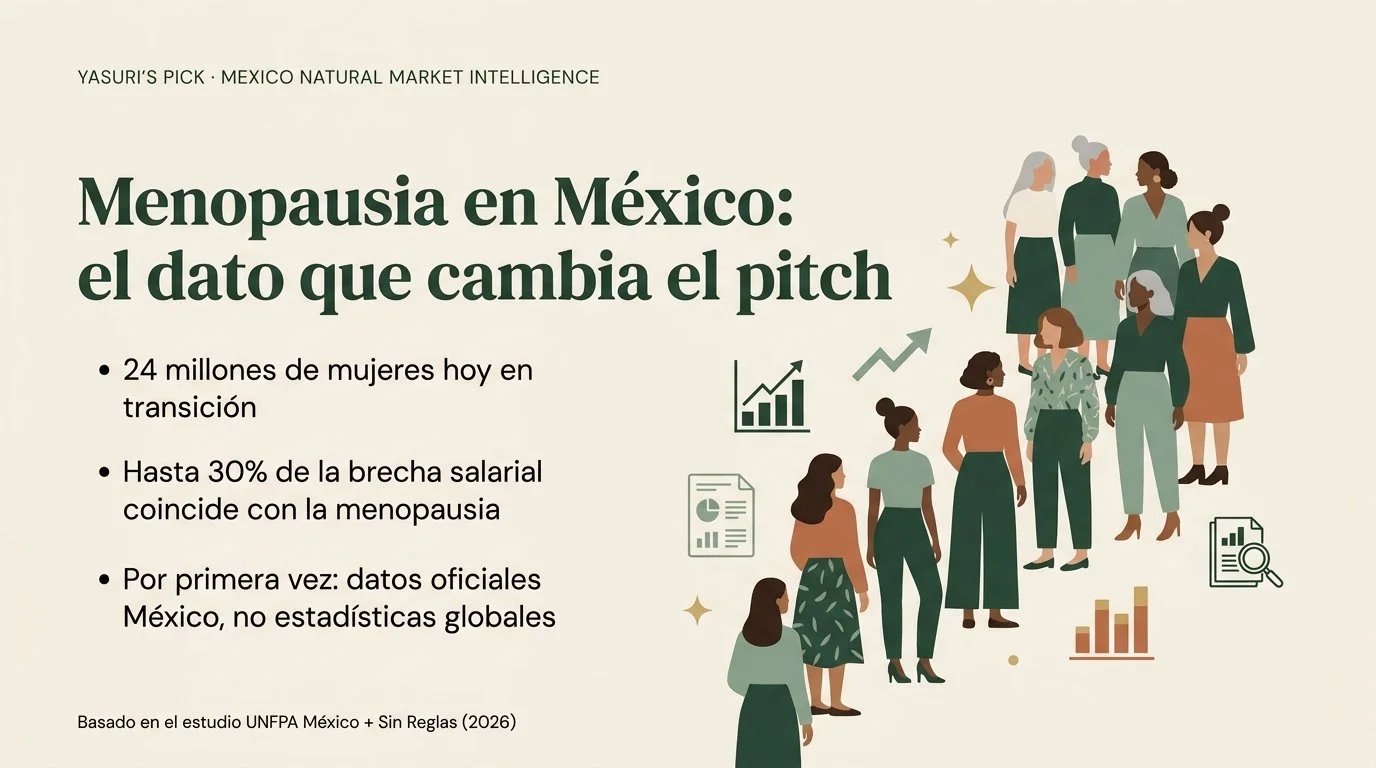
Yasuri's Pick
UNFPA México + Sin Reglas — Estudio sobre los efectos de la transición a la menopausia en la participación económica de las mujeres en México. Public report, January 2026. Free download.
This is the first time a UN agency in Mexico has quantified the economic impact of menopause on the female workforce. Twenty-four million women currently affected. Twenty-seven million projected by 2030. Up to thirty percent of the unexplained gender pay gap coinciding with the menopausal transition.
Here's why this matters specifically for the Mexican market. Every European brand pitching menopause or perimenopause solutions to a Mexican investor, distributor, or hospital network has been citing global numbers and Spanish-translated Statista screenshots. This study replaces all of that with defensible, Mexico-specific, government-recognized data.
It is the only document I currently know of that allows a European brand to walk into a Mexican private gynecology network and have the conversation in the language of public health, not the language of beauty.
The one thing
If you are running an intimate care brand in Sweden, Denmark, the Netherlands, Spain or Germany, and your Mexico entry plan exists in any form for 2026 or 2027, the next sixty days are the window. Align your label and claims with the post COFEPRIS enforcement reality before it catches up to you.
Book a thirty-minute free diagnostic with YMC. We will read your label, your claims, and your positioning, and tell you exactly which words survive Mexico in 2026 , and which words will get your shipment retained at customs.
No deck. No generic playbook. The exact decisions you have to make this month.
