The Window Mexico Hasn't Filled
Método Yasuri™: 7.8/10
'Mexico market intelligence for natural wellness and intimate care brands, from someone who operates here.'
Twenty-five gynecologists in one month.
That's how many private practice OBGYNs I visited in Mérida between January and March. Not all of them bought. But almost all of them asked the same question at some point during our conversation:
What exactly is a postbiotic, and why should I recommend it over what I already prescribe?
That question didn't come from me. Their patients were asking first. Women arriving at consultation mentioning they had read about microbiome-balanced intimate care, that they wanted something without chemicals, that they didn't want antibiotics again for the third recurrent infection in a year. The doctors were being pulled by demand they hadn't created. And they didn't have a clinical answer ready.
That gap, between what Mexican women are searching for and what their gynecologists can confidently recommend, is where the next wave of intimate care brands will either win or lose this market. Not in pharmacies. Not in Sephora. In the 15-minute consultation window where a doctor decides what to put her professional credibility behind.
What I saw in Mérida this quarter is a signal. Not yet a trend. But in a market that moves the way Mexico moves, slowly, then all at once, a signal in the medical channel is worth more than a trend in retail.
MÉTODO YASURI™: The Analysis
Postbiotics in Intimate Care: The Window Mexico Hasn't Filled
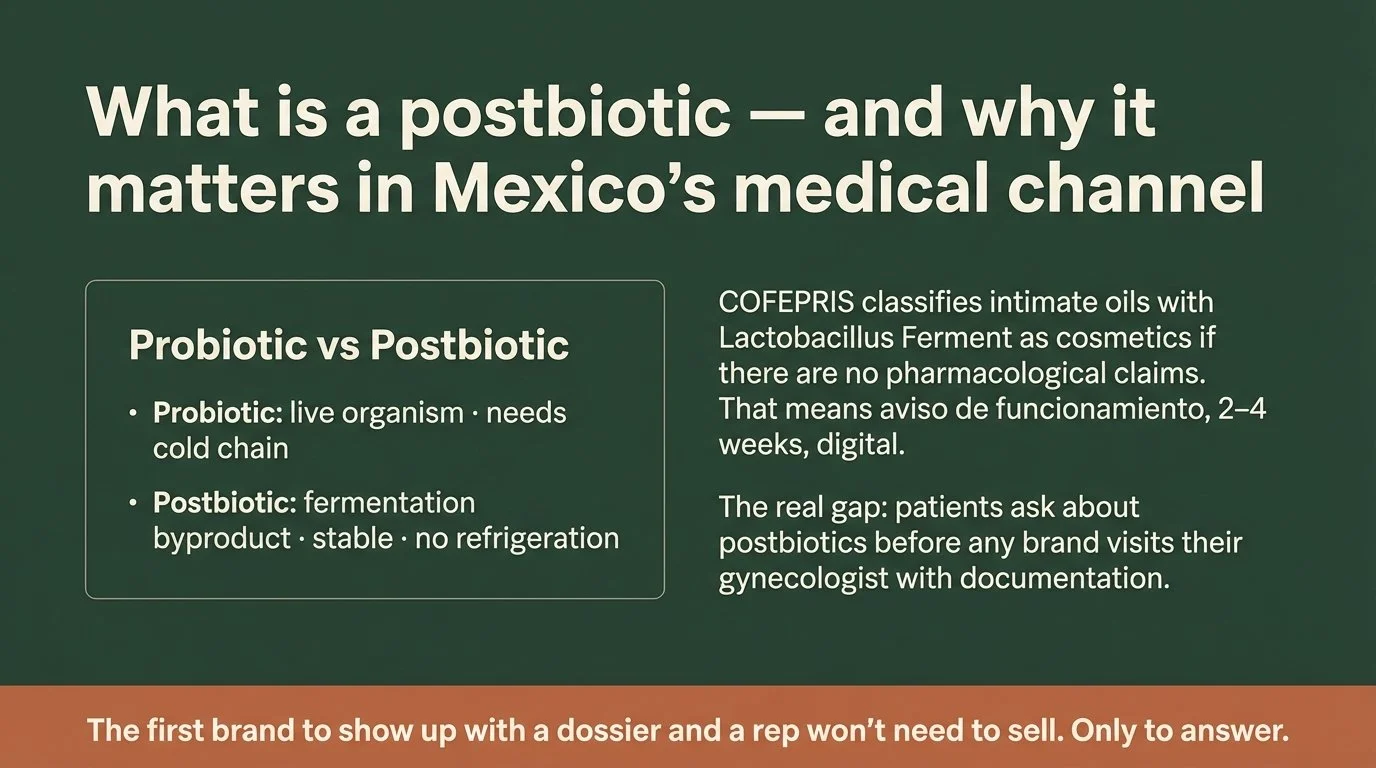
Let me be precise about what postbiotics are, because the word gets used loosely.
A postbiotic is not a live bacterium. It's the structural component or metabolite produced by bacteria, in this case, Lactobacillus, after fermentation. Lactobacillus Ferment, the ingredient you'll find in the INCI list of the product I distribute, is a postbiotic. Stable. No refrigeration needed. It doesn't require the organism to survive transit. And it works on the skin surface in a way that probiotics, which need to survive the entire journey from factory to shelf to skin, often don't.
That distinction matters enormously for Mexico specifically, for two reasons no market report will tell you.
The first is regulatory. COFEPRIS classifies intimate care oils and cleansing formulations as cosmetics, not as health products, as long as they don't make pharmacological claims. The regulatory path to import and sell a postbiotic intimate oil in Mexico is not a full sanitary registration. It's an "aviso de funcionamiento", filed digitally through DIGIPRiS. That's the difference between a six-month process and a two-to-four week one.
“I score the regulatory environment for this specific category at 8 out of 10, meaning the barrier is considerably lower than what most European founders fear when they hear the word COFEPRIS.”
The second reason is biological, and it matters most for the medical channel. Published research, including a 2025 study on vaginal microbiota patterns specifically in Mexican women, confirms that Hispanic populations tend toward higher vaginal bacterial diversity than European populations. That's not a deficiency. It's a biological reality that affects how intimate care formulations perform in this population. A brand that arrives with clinical data calibrated to a Mexican context has something no competitor from abroad carries: credibility with OBGYNs trained to ask difficult questions before recommending anything.
“Commercially, I score this category at 7 out of 10 for viability in Mexico. The market for natural intimate care exists. It’s growing at 22% annually in the import segment.”
Consumer awareness of microbiome health is accelerating, driven not by brands, but by patients asking their doctors questions the doctors can't yet answer. The price point of premium postbiotic intimate care, between MXN 700 and MXN 950 for a 50ml bottle, sits in the accessible-premium range that the Mexican woman who visits a private gynecologist already occupies. This is not a mass-market play. It doesn't need to be.
“For the medical channel specifically, I score the fit at 9 out of 10. ”
The highest score I've given any category in two years of working this channel. Gynecologists in Mérida are being pulled by patient demand, they simply don't have a product with clinical documentation in Spanish to recommend confidently. A brand that shows up with a dossier, a COSMOS Organic certification, a Kind to Biome seal, and a representative who can answer clinical questions face to face is not selling. It's filling a gap the doctor already knows she has.
“Speed of adoption in the Mexican market: 8 out of 10, because the acceleration is demand-led, not education-led. Investment required to enter: 7 out of 10, moderate. ”
"Aviso de funcionamiento", local legal representation, clinical materials in Spanish, and a distributor who understands the medical channel. Not inexpensive. But not the wall it looks like from Stockholm or Brussels.
“Total Método Yasuri™ score for postbiotic intimate care in Mexico in Q2 2026: 39 out of 50. That’s 7.8 out of 10.”
The prediction, specific and verifiable: by Q4 2026, at least one European intimate care brand will announce formal distribution in Mexico citing the medical channel as its primary entry strategy. The brand that moves in Q2 2026 has a 12-month first-mover window. After that, the channel will have an established reference, and conversion rates for new entrants drop significantly.
The window is open. It won't stay open.
What happening in Mexico this moth?
Three things happened in Mexico's beauty and wellness landscape in Q1 that deserve your attention.
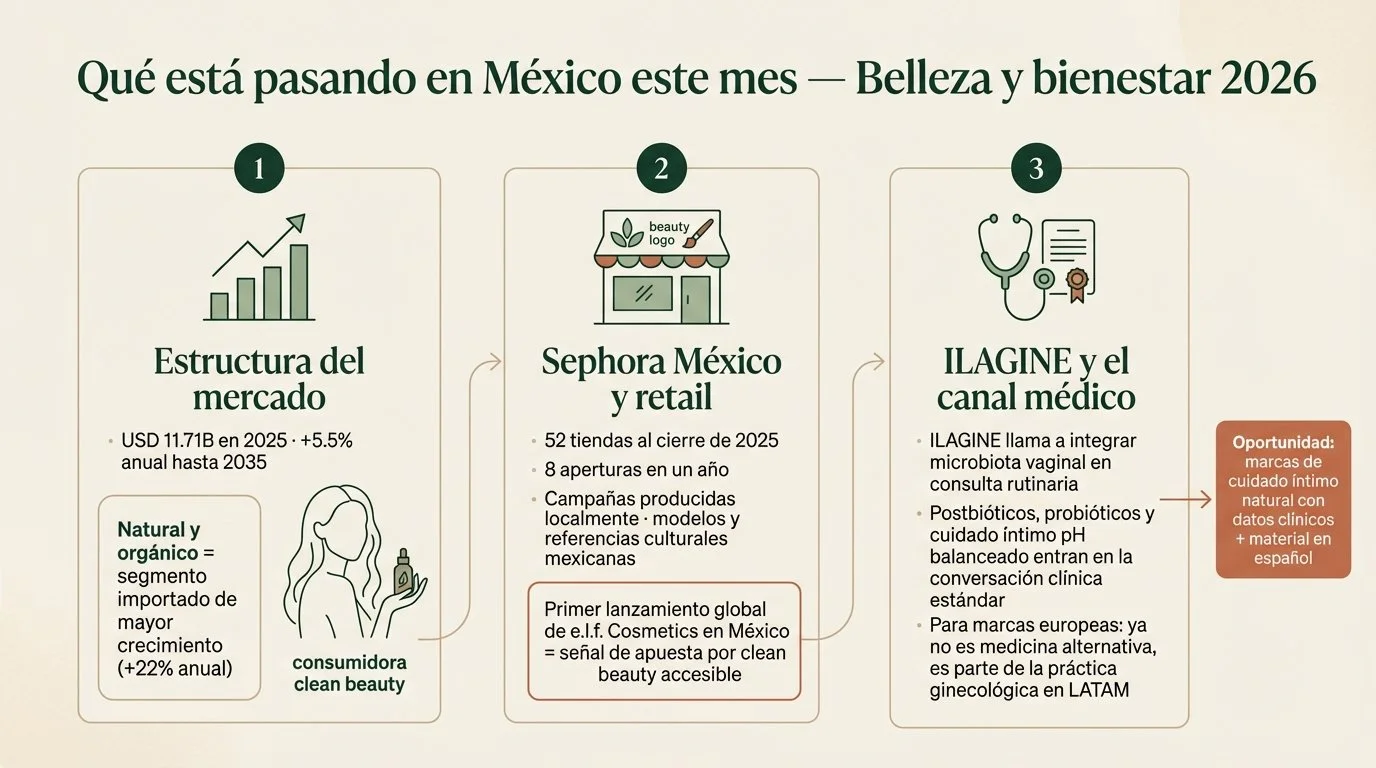
The first is structural. Mexico's cosmetics market closed 2025 at USD 11.71 billion and is projected to grow at 5.5% annually through 2035.
Within that, natural and organic cosmetics are the fastest-growing import segment at 22% annually.
The clean beauty consumer in Mexico is no longer a niche. She is the growth driver. And the distribution infrastructure — pharmacy chains, specialized stores, e-commerce platforms — is calibrating to her, not the other way around.
The second is channel movement. Sephora Mexico closed 2025 with 52 stores after opening eight in a single year. Its general manager for Latin America has been explicit that the chain is actively seeking brands with the right storytelling and producing campaigns locally, with local models and cultural references.
“What she didn’t say, but what is visible in their choices, is that Sephora Mexico is moving faster than any other Sephora market on accessible clean beauty. ”
The first-ever global Sephora launch of e.l.f. Cosmetics happened in Mexico. That is not an accident. It is a declaration about the consumer they are building for.
The third is medical. In late February 2026, ILAGINE, (Institulo Latinoamericano de Ginecologia Funcional), published a call to gynecologists across the region to integrate nutritional and product counseling focused on vaginal microbiota into routine consultations. They framed postbiotics, probiotics, and pH-balanced intimate care as part of the standard gynecological conversation. For a European brand of natural intimate care, this is the institutional signal that the topic is no longer alternative medicine in Latin America. It is entering clinical practice guidelines. The doctors just got permission to talk about it.
CASE STUDY, Lip Intimate Care
Building a Medical Channel From Zero: What Lip Intimate Care Taught Me About Timing
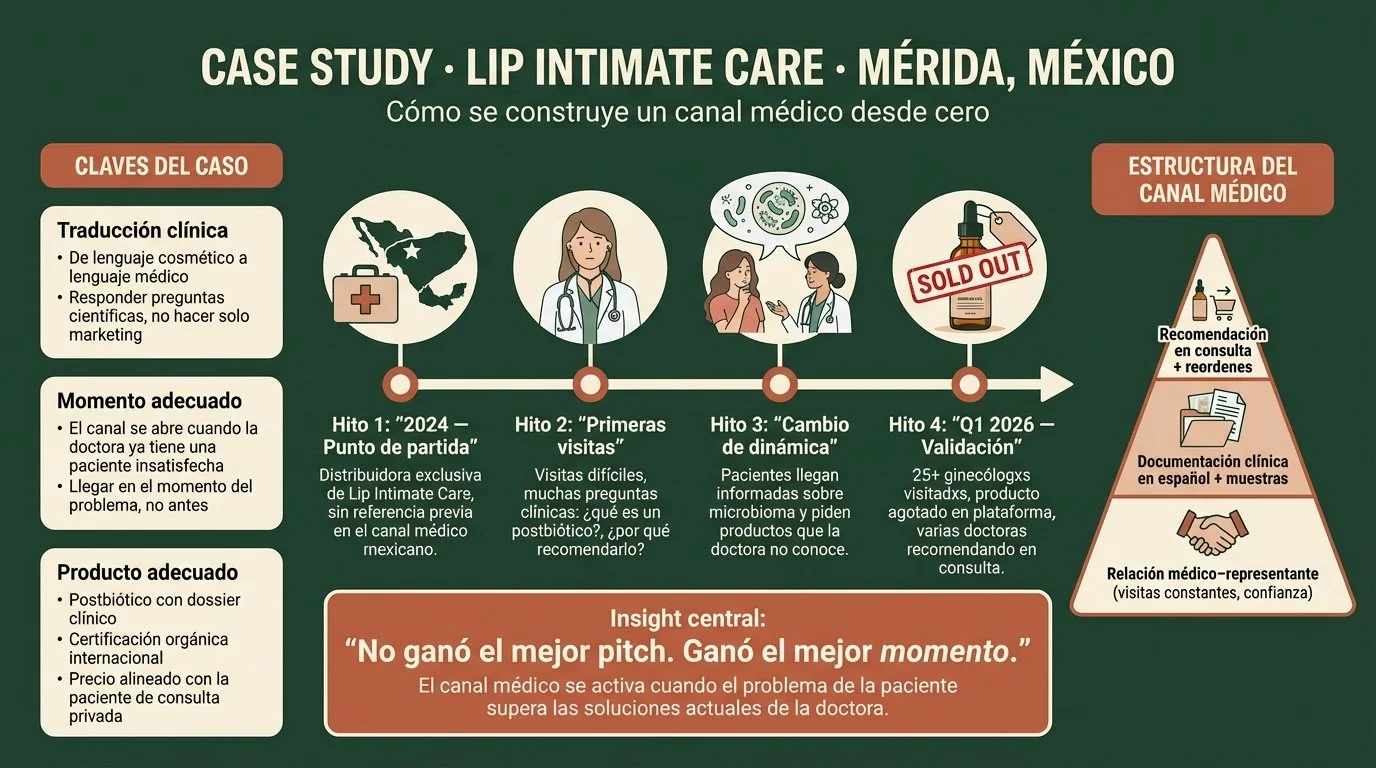
In early 2024, I started visiting gynecologists in Mérida as the exclusive distributor of Lip Intimate Care, a Swedish organic intimate care brand certified COSMOS Organic and Kind to Biome Awards, in Mexico. I had no playbook. There was no precedent for a postbiotic intimate oil in the Mexican medical channel. The product existed in European pharmacies and wellness stores, had won international awards, and had zero brand recognition in Mexico. Zero clinical context a Mexican doctor could reference.
The first visits were, by any measure, difficult. Not because the doctors were hostile, Mexican gynecologists in private practice are generally curious and rigorous, but because the category required translation. Not language translation. Conceptual translation. What is a postbiotic? How does an oil cleanse without stripping the mucosa? Why would I recommend this over the brand they already know? These were legitimate clinical questions. I had to learn to answer them in clinical language, not cosmetic marketing language.
What changed the dynamic was not my pitch. It was the patients.
By late 2024, women were arriving at consultation having already read about microbiome health, having seen content from Mexican and Spanish creators discussing postbiotics and intimate care, and asking their gynecologists for specific products those gynecologists didn't know existed. The doctor was being asked a question she couldn't answer. That is a categorically different conversation from the one where a representative walks in trying to create a need.
By March 2026, after visiting more than 25 gynecologists in Mérida in a single quarter, the pattern is consistent. They are not just listening politely anymore. They are asking about clinical documentation, about whether studies exist in Mexican women specifically, about pricing that works for their patients. The Prebiotic + Postbiotic Cleansing Oil from Lip Intimate Care — priced at MXN 850, certified COSMOS Organic, formulated with Lactobacillus Ferment and Alpha-Glucan Oligosaccharide — is, at the time of writing, sold out on the VULVA & VOZ platform in Mexico. Ten gynecologists have placed orders. Twenty five are recommending the product in consultation without my prompting.
The lesson is not about the product. The lesson is about timing. The medical channel closes when the doctor has a patient problem she cannot solve with what she already has. Showing up before that moment means months of education. Showing up at that moment means you only have to answer. Right now, in Mérida and in CDMX, that moment has arrived.
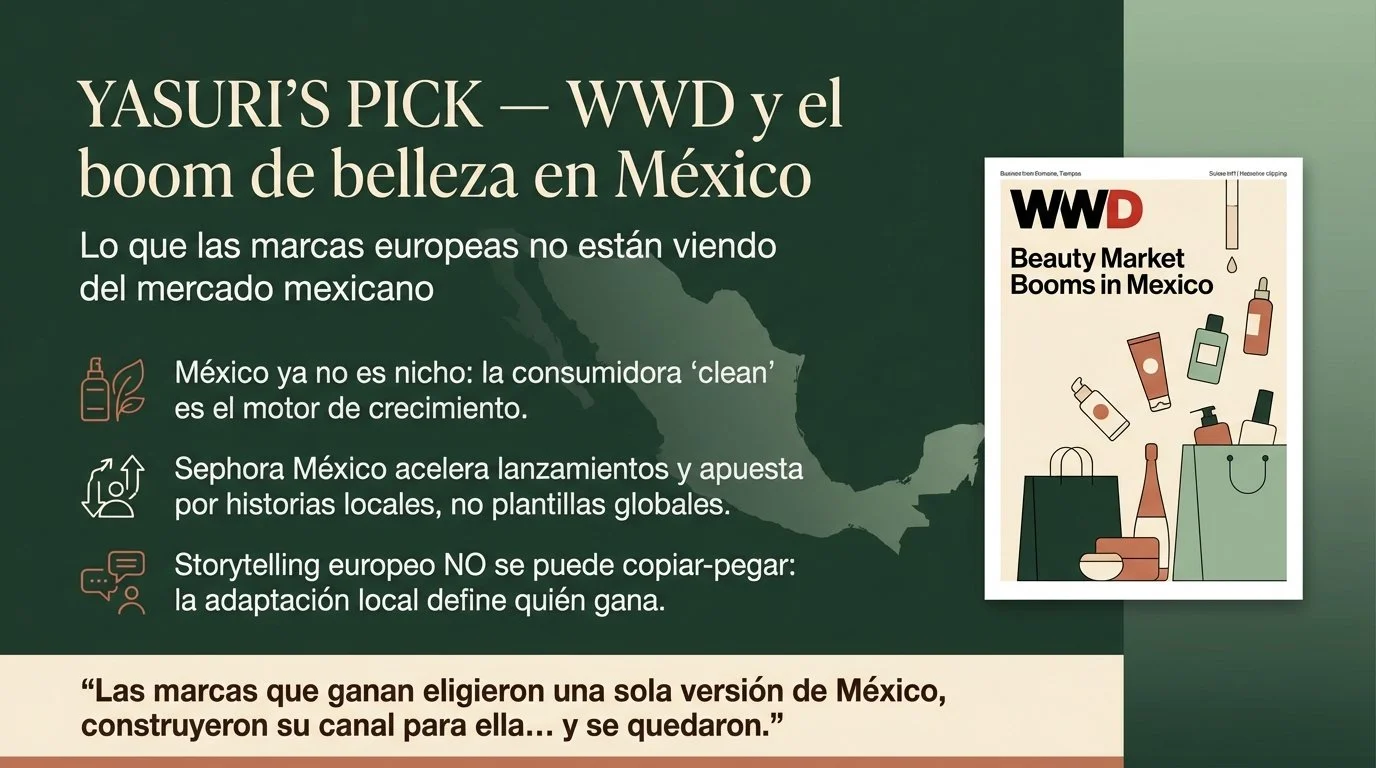
YASURI'S PICK
WWD: "Beauty Market Booms in Mexico: Global Brands and Retailers Eye Expansion" (March 2026)
Women's Wear Daily published one of the clearest-eyed pieces on the Mexican beauty market I've read recently. It's not a forecast built on aggregate data from a desk in New York. It's reporting from inside the market, with direct quotes from Sephora Latin America's leadership, retail expansion numbers, and a portrait of what the Mexican beauty consumer actually looks like in 2026: young, digital, absorbing global trends faster than most international brands realize, and less loyal to prestige labels than European brands assume.
What the piece captures, and what most European market analyses miss, is that Mexico is not one market. The prestige consumer is not the mass consumer. The digital consumer is not the store consumer.
The brands winning right now chose one version of Mexico deliberately, built their channel for it, and stayed.
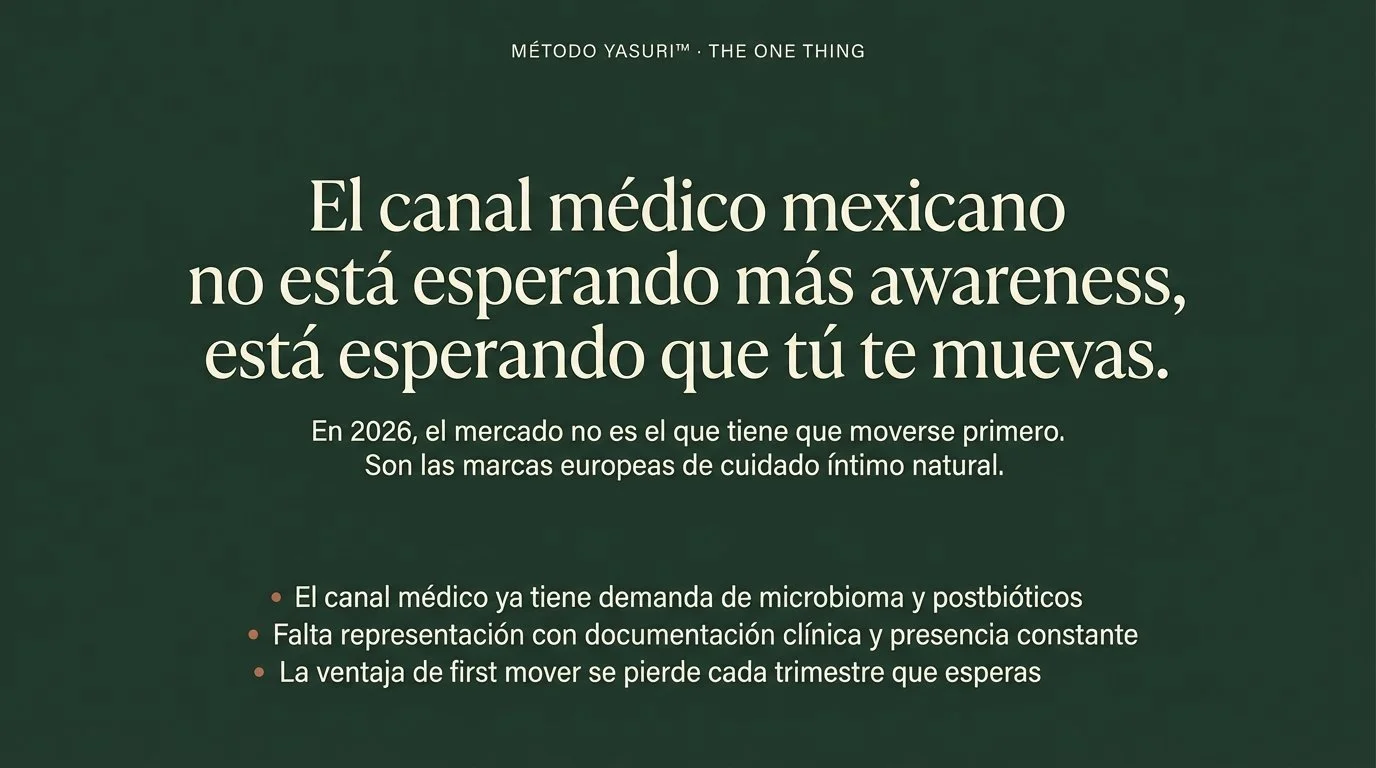
THE ONE THING
The question I get most from European founders considering Mexico is: How do we know when the market is ready for us?
That question assumes the market is the one that needs to move. It doesn't. You do.
Mexico's medical channel for natural intimate care is not waiting for more consumer awareness. It is waiting for a representative who shows up with clinical documentation, speaks the doctor's language, and stays past the first meeting. Awareness campaigns reach the consumer. Consistent presence in consultation rooms reaches the prescriber. These are different markets, with different timelines, and different margins.
If you are a European brand in the intimate care or women's wellness space evaluating Mexico in 2026, I offer a free 30-minute diagnostic. No deck, no generic pitch. A real conversation about whether your product, your regulatory status, and your timeline are aligned with how this market actually works.
